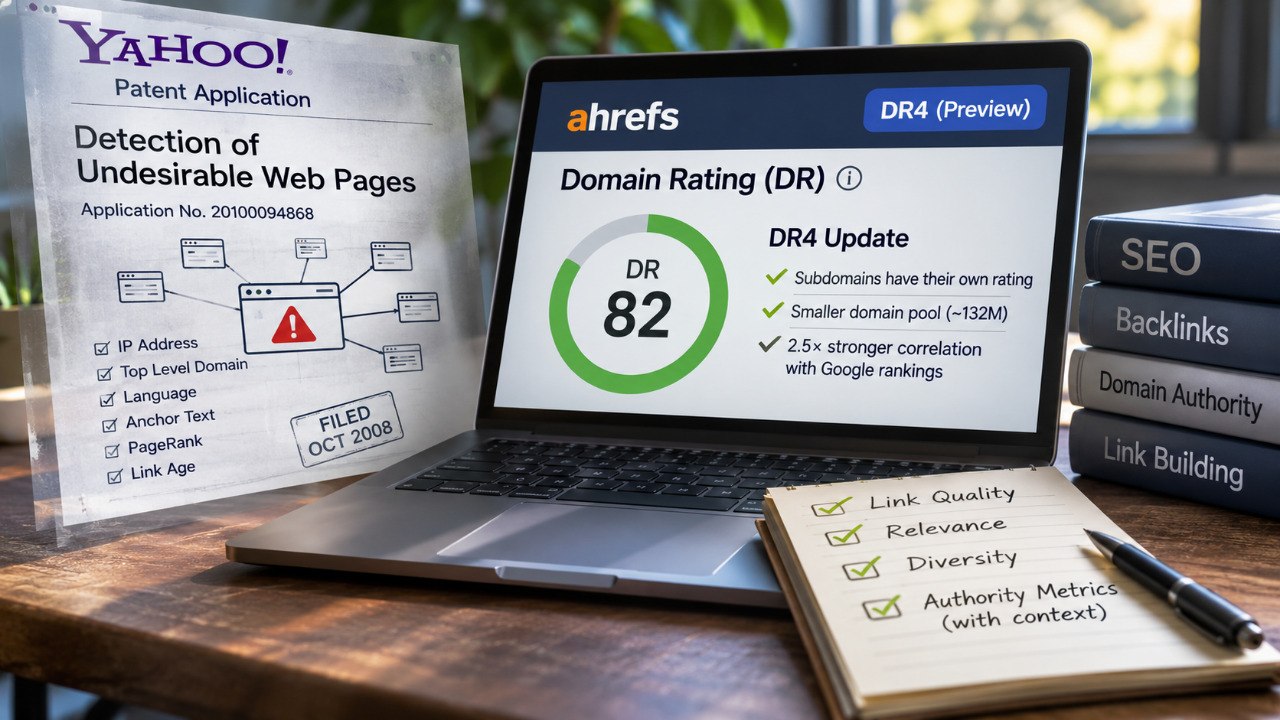
Nearly two decades after Yahoo proposed detecting unnatural backlink patterns, Ahrefs is preparing a major overhaul of Domain Rating. The message for website owners, SEO professionals, and domain investors is clear: not all backlinks are created equal.
The Evolution of Backlink Quality
Backlinks have been a cornerstone of search engine optimization since the earliest days of Google. When website owners discovered that incoming links could influence search rankings, an entire industry emerged around link building.
Some strategies focused on earning genuine editorial recommendations. Others relied on buying links, exchanging links, creating link farms, and building networks of websites designed primarily to manipulate search results.
Search engines quickly realized that counting links was not enough. They needed ways to distinguish genuine endorsements from artificial attempts to influence rankings.
An interesting example of this challenge dates back to 2008, when Yahoo filed a patent application describing a statistical approach to identifying suspicious backlink patterns.
Now, in November 2026, Ahrefs is preparing to introduce Domain Rating version 4 (DR4), a significant update to one of the SEO industry's most widely recognized backlink metrics.
Although these developments serve different purposes, they illustrate an important evolution in SEO: the quality, diversity, and credibility of backlinks matter far more than their raw quantity.
2008: Yahoo's Early Warning About Link Manipulation
In October 2008, Yahoo filed a patent application titled Detection of Undesirable Web Pages, published in April 2010 as US patent application 20100094868.
The application described a method for detecting potentially manipulated backlink profiles through statistical analysis.
Rather than simply counting incoming links, Yahoo proposed examining the distribution of characteristics across websites linking to a particular destination.
These characteristics included:
- IP addresses: Whether incoming links originate from a suspicious concentration of servers.
- Top-level domains: Whether backlinks come from a diverse range of domain extensions.
- Languages: Whether the linguistic distribution of linking pages appears unusual.
- Autonomous systems: Whether backlinks are concentrated within particular hosting networks.
- Anchor text: Whether links repeatedly use identical or unusually optimized keywords.
- PageRank: The relative importance of pages providing incoming links.
- Link age: How backlink characteristics change over time.
One particularly interesting aspect was the use of normalized entropy, a statistical measurement that can describe how concentrated or evenly distributed certain characteristics are.
In simplified terms, a backlink profile with an unusual concentration of identical characteristics could warrant closer examination.
For example, imagine a website suddenly receiving 5,000 backlinks, almost all using the same commercial keyword as anchor text and originating from a small number of hosting networks.
Such a pattern might suggest coordinated link creation rather than independent editorial recommendations.
However, an unusual statistical pattern is not necessarily proof of manipulation. Legitimate websites can also experience sudden publicity, concentrated coverage, or similar linking behavior.
Yahoo's patent described a potential detection method, not a universal rule that every backlink profile must follow.
It is also important to distinguish a patent application from evidence of implementation. The application demonstrates what Yahoo was researching, but does not establish that the proposed method was deployed in its search engine.
2026: Ahrefs Prepares a Major Domain Rating Update
Fast-forward to November 2026.
Ahrefs, one of the leading providers of SEO analytics, is preparing to introduce Domain Rating version 4 (DR4), scheduled to become the default model on December 1, 2026.
Domain Rating, commonly abbreviated DR, is a proprietary metric designed to estimate the relative strength of a website's backlink profile on a logarithmic scale from 0 to 100.
According to an announcement shared by Glen Allsopp of Detailed, which was acquired by Ahrefs, the new DR4 model introduces two particularly important changes.
1. Subdomains Receive Their Own Ratings
Under the new model, subdomains will be evaluated more independently from their parent domains.
For example, a company's primary website might have a Domain Rating of 92, while its help desk subdomain receives a rating of 75.
This distinction matters because subdomains can host very different types of content, attract different backlinks, and operate with different editorial standards.
For SEO professionals, this could provide a more meaningful way to evaluate links from specific subdomains instead of assuming they share the same authority as the root domain.
2. A Smaller Pool of Domains Influences DR
The second major change concerns the number of domains contributing to Domain Rating calculations.
According to the announcement, the pool of domains influencing DR has been reduced by approximately half, to around 132 million.
This suggests a substantial change in which linking domains contribute to the model, although the announcement alone does not explain every criterion behind that selection.
Ahrefs also reports that DR4 demonstrates more than 2.5 times the correlation with Google rankings across all hosts compared with its previous model in internal testing.
That is an interesting claim, but it should be interpreted carefully.
Correlation does not establish causation, and Domain Rating is not an official Google ranking factor.
Nevertheless, the update could make DR4 more useful as a comparative backlink analysis metric.
How Much Could Domain Ratings Change?
Early examples published by Domain Name Wire illustrate how significantly scores may shift under DR4.
| Website | Previous DR | DR4 Preview |
|---|---|---|
| DomainNameWire | 79 | 82 |
| NameBio | 76 | 79 |
| DNJournal | 81 | 89 |
| Ranks | 38 | 46 |
| Atom | 90 | 89 |
| DomainSmoke | 27 | 25 |
These examples demonstrate that the update is not simply increasing every website's rating.
Some domains receive higher scores, while others decline.
Importantly, a change in DR does not necessarily indicate that a website has gained or lost backlinks, or that its actual Google rankings have changed.
It may simply reflect a different measurement methodology.
Website owners and domain investors can preview the new scores using the DR4 preview tool before the planned December rollout.
What Yahoo's Patent and Ahrefs DR4 Have in Common
Yahoo's historical patent and Ahrefs' new Domain Rating model are not the same technology.
Yahoo was exploring ways to identify potentially undesirable websites and unnatural link structures within a search engine context.
Ahrefs is refining a third-party metric for evaluating backlink profile strength.
However, both developments highlight the limitations of evaluating backlinks using simplistic measurements.
Consider two hypothetical websites.
Website A has 20,000 backlinks generated primarily through automated directories, low-quality websites, repeated anchor text, and coordinated link exchanges.
Website B has 800 backlinks earned through industry publications, relevant resource pages, independent reviews, and genuine editorial references.
Website A has more backlinks, but that does not automatically mean it has a stronger or more trustworthy link profile.
The relevance, independence, credibility, and context of incoming links can be more informative than the total number.
This distinction becomes especially important when evaluating expired domains, purchasing websites, or considering paid link placements.
Why Domain Authority Scores Can Be Misleading
The SEO industry uses several popular third-party metrics, including:
- Domain Authority (DA) from Moz.
- Domain Rating (DR) from Ahrefs.
- Trust Flow (TF) and Citation Flow (CF) from Majestic.
- Authority Score (AS) from Semrush.
These metrics can be valuable for comparing websites, identifying backlink opportunities, and monitoring changes over time.
But they are not interchangeable, and none should be treated as a direct measurement of Google's opinion of a website.
A domain with DR 70 is not guaranteed to outrank one with DR 40.
Likewise, a website can have an impressive authority score while attracting little organic search traffic.
This creates a particular risk for domain investors and website owners who purchase links or domains based primarily on third-party metrics.
Artificially increasing a score does not necessarily produce sustainable search visibility, qualified visitors, or revenue.
A high authority score is a measurement, not a business outcome.
Seven Practical Lessons for SEO in 2026
The combination of Yahoo's historical research and Ahrefs' upcoming DR4 update offers several practical lessons.
1. Prioritize Relevance Over Raw Link Counts
A backlink from a genuinely relevant website can be more useful than dozens of unrelated links.
Focus on websites that serve audiences interested in your industry, products, or expertise.
2. Examine Backlink Patterns, Not Just Totals
Review referring domains, anchor text distribution, link growth, and the quality of linking pages.
Unusual patterns deserve investigation, although they should not automatically be interpreted as spam.
3. Evaluate Subdomains Separately
With DR4 introducing more independent subdomain ratings, SEO professionals should pay closer attention to where links actually originate.
A backlink from a user-generated subdomain should not automatically be valued like an editorial link from a publisher's main website.
4. Avoid Manipulative Link Schemes
Mass-produced backlinks, private blog networks created for ranking manipulation, and paid links intended to pass ranking credit can create unnecessary SEO risks.
Google's spam policies specifically address manipulative link practices.
Paid advertising and sponsorship links should use appropriate attributes, such as rel="sponsored" or rel="nofollow" where applicable.
5. Look Beyond DR and DA
Evaluate organic traffic trends, topical relevance, editorial quality, indexability, audience engagement, and referring-domain credibility.
No single metric provides a complete picture.
6. Monitor the DR4 Transition
If you regularly track Ahrefs Domain Rating, record your current scores before December 1, 2026.
After the update, distinguish changes caused by the scoring model from actual developments in your backlink profile.
Historical comparisons may otherwise become misleading.
7. Build Links Worth Earning
Useful research, original tools, industry guides, practical resources, and genuinely valuable content can attract independent editorial references.
This approach requires more effort than purchasing bulk backlinks, but it can create lasting value beyond a single SEO metric.
What Does This Mean for Web Directories?
Web directories have played an important role in internet history, from the early Yahoo Directory to thousands of specialized business and resource directories.
Unfortunately, automated link submissions and low-quality directory networks also became common tools for manipulating search rankings.
That history does not mean every directory link is inherently worthless.
A well-maintained directory can still help users discover useful websites, especially when it serves a clearly defined industry, geographic area, or audience.
The distinction lies in its purpose and editorial standards.
A directory designed primarily to help visitors find relevant resources offers a fundamentally different experience from one created solely to distribute keyword-rich backlinks.
For directory operators, quality control matters. Useful descriptions, relevant categories, transparent submission policies, moderation, and the removal of spam can all improve the directory's value to visitors.
For website owners, directory submissions should be considered a potential discovery and referral channel, not a guaranteed method of increasing search rankings.
Paid directory placements intended to influence rankings must also be handled consistently with search engine spam policies.
The Future of Backlink Analysis
From Yahoo's patent application in 2008 to Ahrefs' DR4 update in 2026, backlink evaluation has become increasingly sophisticated.
The SEO industry has moved far beyond simply counting incoming links.
Modern backlink analysis involves understanding where links originate, how they relate to a website's subject matter, whether they represent independent recommendations, and how well third-party metrics reflect meaningful search visibility.
Ahrefs DR4 represents another step in that evolution, but it will not eliminate the need for human judgment.
A backlink profile cannot be fully understood through a single number.
For website owners, publishers, and SEO professionals, the long-term strategy remains straightforward:
Create something genuinely useful, earn relevant recommendations, and measure success through real visitors and business results rather than authority scores alone.
The tools will continue to change. The value of genuine recommendations will remain.
Sources and Further Reading
- Yahoo Files Patent App for Discovering SEO Link Spam — Domain Name Wire, April 15, 2010.
- Detection of Undesirable Web Pages — Patent Application — Published April 2010.
- New Domain Rating Scores Coming Soon — Domain Name Wire, November 12, 2026.
- Ahrefs DR4 Preview — Preview upcoming Domain Rating changes.
- Google Search Central: Spam Policies — Official guidance on link spam and manipulative SEO practices.
SubmitCafe.com covers search engine optimization, website performance, domain authority, and practical strategies for building a stronger online presence.